We use cookies to make your experience better. To comply with the new e-Privacy directive, we need to ask for your consent to set the cookies. Learn more.

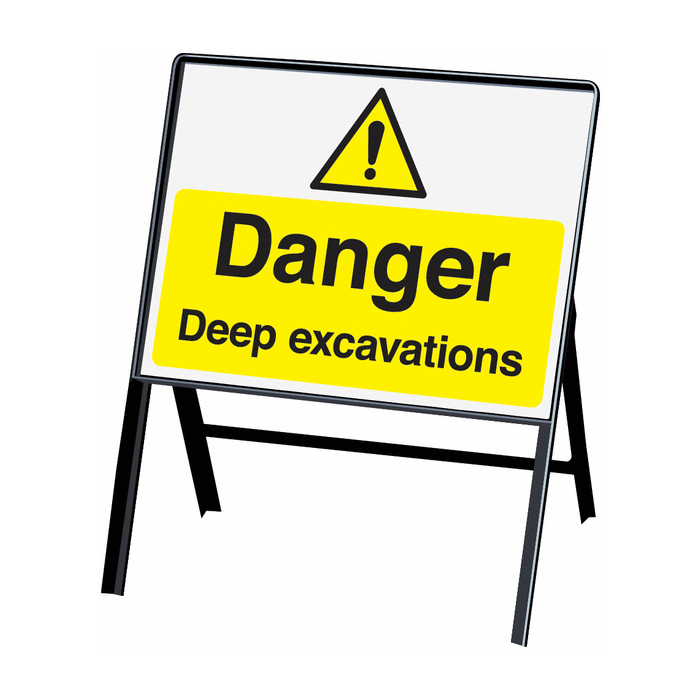
Danger Deep Excavations Stanchion Sign
Danger Deep Excavations Stanchion Sign is a freestanding hazard warning sign for construction, civil engineering and temporary works areas. It helps you alert workers, visitors and contractors before they approach open excavations where a serious fall could occur.
Where Danger Deep Excavations Stanchion Signs Should Be Positioned
You should install this sign at excavation approaches, site entrances, pedestrian routes, temporary barriers and compound edges where people may walk towards open ground. Its freestanding format keeps the warning visible even when no wall, gate or fence is available.
Viewing Distance Guidance for Deep Excavation Warnings
For a 600mm wide stanchion sign, place it where people can read it before changing direction, usually around 10–18 metres in open site conditions. Keep it facing the approach route, not hidden behind plant, skips or stacked materials.
| Size | Practical reading range | Best use |
|---|---|---|
| H 450 x W 600mm | Approx. 10–18 metres | Approach routes, site walkways and temporary excavation edges |
What This Deep Excavation Warning Helps Change On Site
Once installed in the right position, the sign gives people an earlier reason to slow down, reassess their route and stay outside hazardous excavation edges rather than relying on spoken warnings or last-minute barrier visibility.
Danger Deep Excavations Stanchion Sign Specifications
- Sign message: Danger Deep Excavations
- Hazard type: deep excavation warning
- EN ISO 7010 code: W001
- Conforms to EN ISO 7010
- Conforms to BS 5499 sign regulations
- Material: PVC
- Material thickness: 3mm
- Size: H 450 x W 600mm
- Orientation: landscape
- Shape: rectangle
- Background colour: yellow
- Text colour: black
- Symbol colour: black
- Finish: satin
- Fitting method: stanchion mount
Practical Setup Advice for Deep Excavation Stanchion Warnings
❌ Placing it after the excavation edge instead of before the approach
❌ Angling the face away from pedestrians or delivery drivers
❌ Allowing plant, fencing or stored materials to block the message
❌ Using it instead of edge protection around an open trench
❌ Relying on it at night without suitable site lighting
❌ Leaving it unsecured where wind or vehicle movement can turn it
✅ Face the sign towards the first point of approach
✅ Use it with barriers, exclusion routes and supervisor checks
✅ Move it promptly as excavation work progresses across the site
Danger Deep Excavations Stanchion Sign questions answered
What is a Danger Deep Excavations Stanchion Sign used for? It is used to warn people that open excavations, trenches or deep groundworks are nearby and that they should avoid unsafe approach routes.
Why choose a stanchion sign instead of a wall-mounted sign? Choose a stanchion sign when the hazard is temporary, moving or not close to a suitable fixing surface, such as on open construction land.
Where should this excavation warning be placed? Place it before the danger point, facing the direction people approach from, especially near pedestrian routes, access gates, temporary barriers and contractor work areas.
Does this sign replace excavation barriers? No. It supports barriers and site controls, but it should not be used as the only protection around an open excavation or unstable edge.
Is the Danger Deep Excavations Stanchion Sign suitable outdoors? Yes, it is intended for indoor and outdoor display, but you should position and secure it so wind, site traffic or uneven ground cannot reduce visibility.
Danger Deep Excavations Stanchion Sign Features and Site Benefits
- ✓ Freestanding stanchion format for temporary excavation layouts
- ✓ Yellow hazard design with black W001 warning symbol
- ✓ 3mm PVC construction with satin finish
- ✓ Large 450 x 600mm landscape display face
- ✓ Lets you warn people where fixed mounting is not available
- ✓ Makes the fall hazard clear before people reach the edge
- ✓ Easy to reposition as groundworks move across the site
- ✓ Helps visitors and contractors make safer route choices
Temporary hazard signs for excavations and changing site risks
For permanent or repeated water-depth warnings, compare with deep water danger signs around ponds, docks and exposed edges. This helps distinguish excavation risks from open water hazards.
Where the wider site is unsafe, use dangerous site stanchion signage at temporary access points. It gives a broader warning when several hazards are present.
If the excavation sits within active works, add construction work in progress signs near routes and work faces. This helps explain the ongoing activity behind the hazard.
For a stronger restricted-area message, choose do not enter hazard area signs where access should be prevented. Useful near open groundworks and temporary barriers.
For more construction hazard options, view site safety hazard signs for excavations and match warnings to ground, access and work-area risks. This keeps temporary hazards easier to manage.
Estimated Delivery Day
Current date and time:
Estimated delivery by:
Based on an estimated 3 working day delivery timeframe from today, excluding weekends and bank holidays. Delivery dates are provided as a guide only and may vary depending on the product ordered, stock availability at the time of purchase, production or printing lead times.