We use cookies to make your experience better. To comply with the new e-Privacy directive, we need to ask for your consent to set the cookies. Learn more.

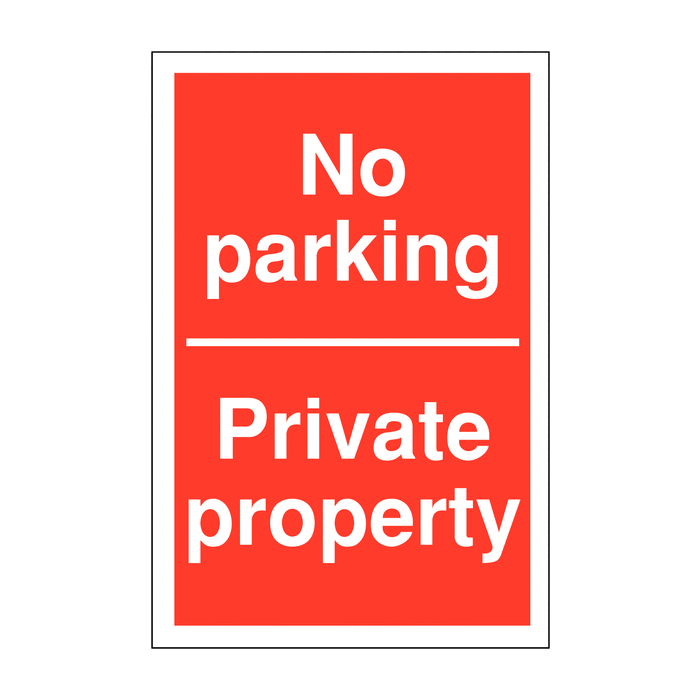
No Parking Private Property Signs
No Parking Private Property Signs tell drivers they must not leave vehicles on private land. They help you protect entrances, gates, yards and residential access points where obstruction causes disputes, delays or unsafe manoeuvres.
Best Places To Fit No Parking Private Property Signs
Install these signs at the first decision point: gates, private entrances, forecourts, yards, access roads and boundary fencing. Put them where drivers can see the message before they stop, turn or block a route.
Choosing A Practical Viewing Distance
Choose the larger 600 x 400 mm option for entrances, wider approaches and areas where drivers approach from a distance. Use 400 x 300 mm for gates, walls and tighter private access points where the sign is read closer up.
| Size option | Best practical reading use |
|---|---|
| H 600 x W 400 mm | Approx. 8–12 metres for entrances, access roads and larger private frontage areas |
| H 400 x W 300 mm | Approx. 5–7 metres for gates, walls, fences and closer driver decision points |
What Improves Once The Sign Is In Position
After installation, the sign gives drivers a clear instruction before they enter or stop. This helps you reduce awkward disputes, keep access routes open and make private parking rules easier to understand.
Specifications
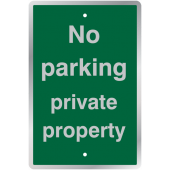
- Sign message: No parking Private property
- Purpose: Prohibits parking on private property
- Sign type: Parking restriction sign
- Display area: Outdoor private land
- Orientation: Portrait
- Shape: Rectangle
- Size options: H 600 x W 400 mm
- Size options: H 400 x W 300 mm
- Materials: Rigid Plastic, Polycarbonate
- Material thickness: Various
- Finish: Glossy film surface
- Supply: Sold individually
- Background colour: Red
- Text colour: White
- Photoluminescent: No
- Reflective: No
- Fixing method: Wall, post or fence mounting
- Fixings: Available separately
Fitting Advice For No Parking Private Property Signs
❌ Do not hide the sign behind gates, shrubs or parked vehicles
❌ Do not fit it so low that vehicles block the message
❌ Do not place it after the point where drivers already stop
❌ Do not use it to control public road parking
❌ Do not rely on it where a formal parking scheme is needed
❌ Do not use it where loading access needs different wording
✅ Fit it at eye level where drivers naturally slow down
✅ Use the larger size on wider entrances and longer approaches
✅ Check visibility in wet weather, darkness and busy parking periods
No Parking Private Property Signs questions answered
What are No Parking Private Property Signs used for? They are used to tell drivers that parking is not allowed on private land, helping you protect access points, entrances and parking-sensitive areas.
Can I use this sign outside my home or business? Yes, when it is displayed on land you own, manage or have permission to control. It should not be used to claim control over a public highway.
Which size should I choose? Use 600 x 400 mm where drivers approach from further away, such as entrances or wider access routes. Use 400 x 300 mm for closer gates, walls or fences.
Is this sign suitable for outdoor use? Yes, it is intended for outdoor display and can be fitted to walls, posts or fencing, with fixings available separately.
Will this stop every unauthorised vehicle? No sign can guarantee behaviour, but clear placement makes your parking rule visible and gives you stronger practical control over private access points.
No Parking Private Property Signs Features And Benefits
- ✓ Bold red background with clear white text
- ✓ Two size options for different approach distances
- ✓ Rigid Plastic and Polycarbonate material choices
- ✓ Portrait format suited to gates, posts and fencing
- ✓ Helps drivers understand restrictions before stopping
- ✓ Reduces blocked access to private entrances
- ✓ Supports clearer parking control without lengthy wording
- ✓ Gives your property boundary a stronger visual instruction