We use cookies to make your experience better. To comply with the new e-Privacy directive, we need to ask for your consent to set the cookies. Learn more.

No Photography Signs
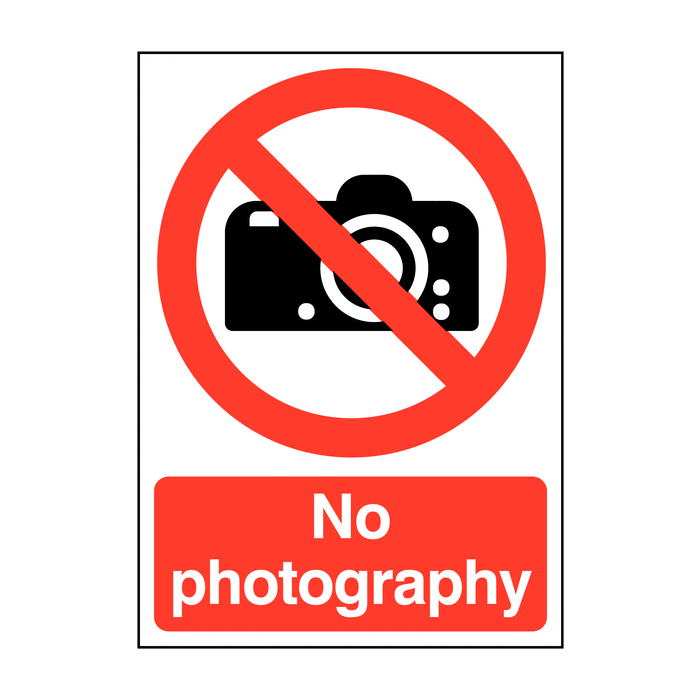
No Photography Signs show that cameras, phones or recording equipment must not be used in controlled areas. They help you protect privacy, confidential work, residents, pupils, patients or security-sensitive operations by giving staff, visitors and contractors a clear rule before entry.
Where No Photography Signs Should Be Positioned
Install No Photography Signs at entrances, reception points, restricted doors, workshops, research rooms, schools, healthcare areas, archives, control rooms and private property boundaries. Position them before people can raise a camera so the rule is visible before access is granted.
Viewing Distance Guidance for No Photography Signs
Choose the size by how far away the restriction must be understood. Smaller signs suit doors and close approach points; larger A2 or A1 formats work better across lobbies, warehouse entrances, public access routes or outdoor boundaries.
| Size | Best viewing use |
|---|---|
| H 210 x W 148 mm | Close-range doors, counters and small rooms, around 2–4 metres |
| H 297 x W 210 mm | Reception areas, internal doors and corridor approaches, around 4–6 metres |
| H 420 x W 297 mm | Busy entrances, workshops and visitor routes, around 6–10 metres |
| H 594 x W 420 mm | Large foyers, production areas and outdoor approaches, around 10–15 metres |
| H 841 x W 594 mm | Longer-distance public boundaries, vehicle approaches and wide access points, around 15–25 metres |
What No Photography Signs Help You Achieve
After installation, the sign gives you a visible boundary for camera use, so visitors do not have to guess and staff can enforce restrictions more consistently. It supports privacy control where one unauthorised image could create a security, safeguarding or confidentiality issue.
No Photography Signs Technical Specification
- Sign message: No photography
- Purpose: Prohibits camera use
- Sign type: Prohibition sign
- EN ISO 7010 code: P029
- Pictogram: Camera crossed by red prohibition symbol
- Text colour: White
- Background colour: Red and white
- Shape: Rectangle
- Orientation: Portrait
- Materials: Rigid Plastic, self-adhesive Vinyl, Removable Repositionable Vinyl
- Finish: Glossy film surface
- Photoluminescent: No
- Reflective: No
- Supply: Single sign
- Size options: H 210 x W 148 mm, H 297 x W 210 mm, H 420 x W 297 mm, H 594 x W 420 mm, H 841 x W 594 mm
- Display area: Indoor and outdoor use
- Where to use: Secure, private and sensitive access areas
- Rigid Plastic fixing: Wall or door mount with separate fixings
- Vinyl fixing: Adhesive backing
- Repositionable option: Can be removed and re-positioned
- Designed with BS 5499 safety sign principles
Installing No Photography Signs Without Creating Confusion
❌ Do not hide the sign behind reception furniture, plants or open doors.
❌ Do not place it after people have already entered the restricted area.
❌ Do not use a small format where visitors approach from a distance.
❌ Do not rely on the sign alone for highly secure photography controls.
❌ Do not use removable vinyl on dirty, damp or uneven surfaces.
❌ Do not choose adhesive vinyl if the surface is likely to peel or flake.
✅ Install at eye level where visitors naturally pause or enter.
✅ Use larger sizes at wide entrances, public approaches and long corridors.
✅ Match the material to the surface, cleaning routine and permanence required.
No Photography Signs questions answered
What are No Photography Signs used for? They show that photography, camera use or recording is not allowed in a specific place, helping you protect privacy, security and sensitive information.
Where should I place a no photography sign? Put it before the point where the restriction applies, such as at entrances, reception desks, controlled doors, schools, healthcare areas, archives or private rooms.
Which material should I choose? Use rigid plastic for durable wall mounting, self-adhesive vinyl for smooth doors or glass and removable repositionable vinyl where the layout may change.
Is this sign suitable outdoors? Yes, it can be used indoors or outdoors when the chosen material and fixing method suit the surface, weather exposure and expected handling.
Does the pictogram follow EN ISO 7010? Yes, the no photography symbol is EN ISO 7010 P029, making the restriction recognisable without relying only on written text.
No Photography Signs Features and Practical Benefits
- ✓ Uses the EN ISO 7010 P029 no photography pictogram
- ✓ Clear red prohibition format with camera graphic and text
- ✓ Available in rigid, adhesive and repositionable material options
- ✓ Multiple portrait sizes for doors, walls and larger access points
- ✓ Helps you stop camera use before people enter controlled spaces
- ✓ Reduces privacy, safeguarding and confidentiality risks
- ✓ Gives staff a visible rule to refer to when challenging behaviour
- ✓ Lets you choose a fixing style that suits temporary or permanent use
Compare no photography signage for different spaces
For wider walls, counters or shared public areas, the landscape no photography allowed signs give you a broader message layout. They work well where visitors need to notice the restriction before entering or recording.
If you are fitting several areas at once, the multi-pack no photography signs help keep your camera policy consistent. Use them across schools, museums, offices and controlled visitor routes.
For more camera restriction choices, view the no photography signs category before choosing your final format. It is useful when you need to match sign style to the layout of your building.
Estimated Delivery Day
Current date and time:
Estimated delivery by:
Based on an estimated 3 working day delivery timeframe from today, excluding weekends and bank holidays. Delivery dates are provided as a guide only and may vary depending on the product ordered, stock availability at the time of purchase, production or printing lead times.