We use cookies to make your experience better. To comply with the new e-Privacy directive, we need to ask for your consent to set the cookies. Learn more.

No Thoroughfare Signs
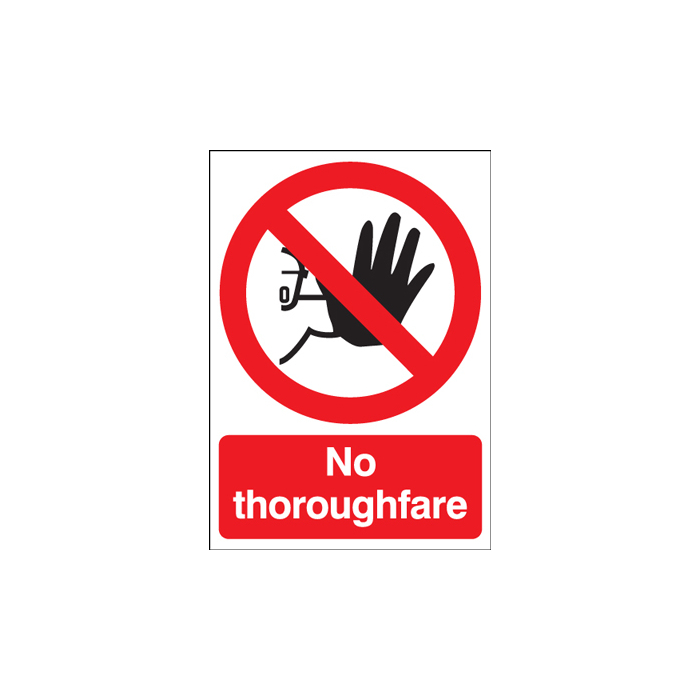
No Thoroughfare Signs tell people they must not continue along a route, helping you control pedestrian access in workplaces, schools, warehouses, service yards and private premises where an open route could create confusion, trespass or unsafe movement.
Where No Thoroughfare Signs Should Be Positioned
You should install these signs at the point where a person is likely to make a route decision, such as corridor ends, gate entrances, private pathways, service doors, warehouse aisles and staff-only cut-throughs, so the restriction is clear before they enter.
Viewing Distance Guidance for Clear Access Decisions
Choose the size by how early you need people to react. Smaller signs suit close-up door or corridor use, while larger formats work better across open yards, entrances and longer approach routes of several metres.
| Size option | Practical viewing guide | Typical placement |
|---|---|---|
| H 210 x W 148 mm | Close range, around 2–4 metres | Doors, corridors, reception routes |
| H 297 x W 210 mm | Short approach, around 4–7 metres | Internal walkways, staff routes |
| H 420 x W 297 mm | Medium approach, around 7–10 metres | Gates, yards, larger entrances |
| H 594 x W 420 mm | Longer approach, around 10–15 metres | Open sites, perimeter access points |
What Changes After Installing No Thoroughfare Signs
Once fitted at the correct decision point, the sign helps people stop, reassess and choose an authorised route instead of walking into restricted, private or unsuitable areas where movement could disrupt work or create risk.
No Thoroughfare Signs Technical Specification
- Sign message: No thoroughfare
- Purpose: stops unauthorised route use
- Sign type: prohibition
- EN ISO 7010 code: P004
- Pictogram: no thoroughfare symbol
- Conforms to EN ISO 7010
- Follows BS 5499 sign guidance
- Where to use: access decision points
- Materials: rigid plastic, self-adhesive vinyl, removable repositionable vinyl
- Size options: H 594 x W 420 mm, H 420 x W 297 mm, H 297 x W 210 mm, H 210 x W 148 mm
- Background colour: red and white
- Text colour: white
- Symbols colour: red and black
- Finish: glossy film surface
- Shape: rectangle
- Orientation: portrait
- Non-photoluminescent
- Non-reflective
- Supplied as: single sign
- Display area: indoors and outdoors
- Fixing: wall or door mounting
Fitting Advice for No Thoroughfare Access Signs
❌ Fitting the sign after the person has already entered the restricted route.
❌ Mounting it too low behind bins, parked vehicles or stored goods.
❌ Using a small format on a wide entrance where people approach from distance.
❌ Do not use it where a formal emergency exit route must remain available.
❌ Do not rely on it alone where physical access control is required.
❌ Do not use it to manage vehicle-only risks without matching vehicle safety signs.
✅ Position it at eye level beside the route or directly on the access door.
✅ Match the sign size to the approach distance and lighting conditions.
✅ Keep the route message consistent with barriers, doors, maps and staff instructions.
No Thoroughfare Signs questions answered
What are No Thoroughfare Signs used for? They are used to tell people that a route must not be used as a through route, helping you control access before someone enters a restricted or unsuitable area.
Where should I place a no thoroughfare sign? Place it where the decision happens, such as at a gate, corridor end, private path, service door, staff-only route or yard entrance.
Is this the same as a no entry sign? Not exactly. No entry usually blocks entry to an area, while no thoroughfare tells people the route should not be used for passing through.
Which material should I choose? Use rigid plastic for tougher fixed locations, self-adhesive vinyl for smooth indoor surfaces and removable repositionable vinyl where layouts may change.
Do these signs use the ISO 7010 P004 symbol? Yes, the sign uses the recognised P004 no thoroughfare prohibition pictogram with supporting text to improve understanding.
No Thoroughfare Signs Features and Benefits
- ✓ Uses the ISO 7010 P004 prohibition pictogram for recognisable access control.
- ✓ Clear “No thoroughfare” wording supports the symbol for quick understanding.
- ✓ Available in rigid plastic, adhesive vinyl and removable repositionable vinyl.
- ✓ Portrait design with red, white and black prohibition colours for high contrast.
- ✓ Helps you stop people entering routes that are not intended for through access.
- ✓ Reduces awkward confrontations by making the restriction clear before entry.
- ✓ Gives you flexible fitting choices for permanent, temporary or changing layouts.
- ✓ Supports safer pedestrian flow around private, operational or controlled areas.
Signs for closed routes and controlled access
For repeated route closures, choose no thoroughfare signs in packs of 6 where several routes need the same message. Useful for corridors, yards and temporary closed paths.
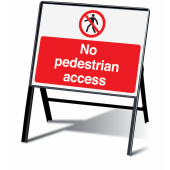
If pedestrian entry is the main risk, compare no pedestrian access prohibition signs for stronger access control. Suitable for unsafe walkways, maintenance areas and vehicle approaches.
For moveable closure points, use footpath closed stanchion signs when the route changes during works. Helpful for temporary paths, repairs and public-facing access points.
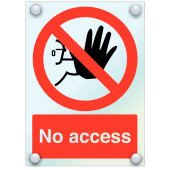
Where a general access stop is needed, consider no access stanchion signs at the approach. They help create an immediate visual barrier without permanent fixing.
For more pedestrian restriction choices, view no thoroughfare and pedestrian prohibition signs together. This helps you choose between route closure, entry restriction and footpath control wording.
Estimated Delivery Day
Current date and time:
Estimated delivery by:
Based on an estimated 3 working day delivery timeframe from today, excluding weekends and bank holidays. Delivery dates are provided as a guide only and may vary depending on the product ordered, stock availability at the time of purchase, production or printing lead times.