We use cookies to make your experience better. To comply with the new e-Privacy directive, we need to ask for your consent to set the cookies. Learn more.

Wheelchair Ramp Access Signs
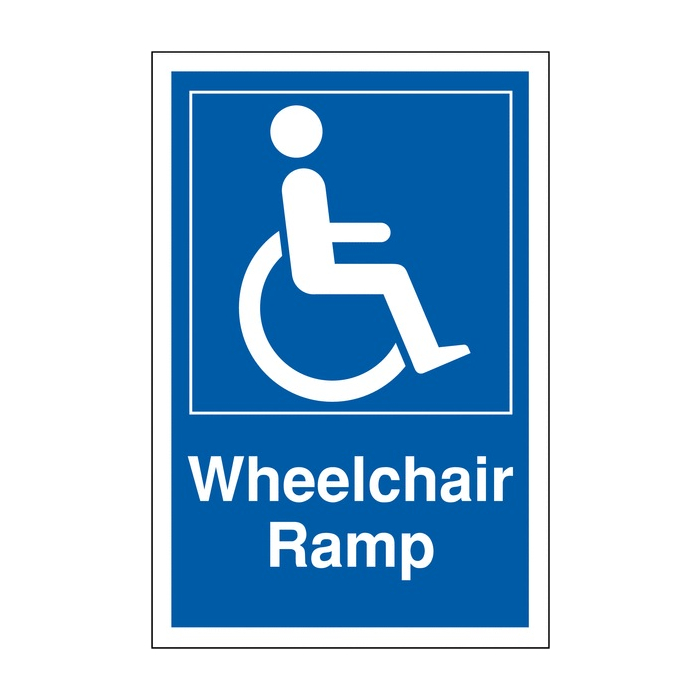
Wheelchair Ramp Access Signs show people with mobility needs where step-free ramp access is available. They help wheelchair users, visitors, staff and carers in workplaces, shops, schools, healthcare settings and public buildings by reducing uncertainty at entrances, paths and service areas.
Best places to position this access sign
You should install this sign at the ramp entrance, beside the approach path and at any point where visitors may hesitate between steps and step-free access. Keep it at eye level, clear of door swings and obstructions, so the ramp is visible before someone commits to the wrong route.
Viewing distance guidance
Choose the size by how early the ramp needs to be seen. Smaller entrances suit close-range reading; open approaches, car parks and longer corridors need a larger face so people can change direction without stopping or doubling back.
| Size option | Practical viewing distance | Best fit |
|---|---|---|
| H 400 x W 300 mm | Approx. 4–8 metres | Doors, reception approaches and short internal paths |
| H 600 x W 400 mm | Approx. 8–15 metres | External approaches, car parks and longer corridors |
Expected Safety Outcomes After Installation
After installation, the sign should prompt visitors to choose the ramp earlier, reduce hesitation near steps and keep access points easier to identify. It works best when positioned before the decision point, not after the visitor has already reached the wrong entrance.
Specifications
- Sign message: “Wheelchair Ramp”
- Purpose: identify ramped access point
- Pictogram symbol: ♿ wheelchair user
- Sign type: DDA Access
- Shape: rectangle
- Orientation: portrait
- Background colour: blue
- Text colour: white
- Contrast: white on blue
- Symbols colour: white
- Material options: Polycarbonate, Plastic, Rigid Plastic
- Size option: H 400 x W 300 mm
- Size option: H 600 x W 400 mm
- Finish: glossy film surface/satin
- Non-Photoluminescent
- Non-reflective
- Supplied in single
- Size choice: larger sign for longer approach
- Display area: indoors/outdoors
- Where to use: ramp entrances and approach points
- Fitting methods: wall/post/wire fence mount
- Rigid Plastic fixings: sold separately
- Polycarbonate fitting: cable ties sold separately
- Post mount fittings: sold separately
- Material thickness: varies by material
- ISO 7001 code: PI PF 022 ramped access
- EN ISO 7010 code: no valid code assigned
Installation Guidance
❌ Placing the sign after the ramp starts, where the decision has already been made
❌ Mounting it behind parked vehicles, bins, plants or open doors
❌ Putting it too high, too low or angled away from seated eye lines
❌ Do not use it to imply a ramp is suitable if the surface, gradient or clearance is poor
❌ Do not use it as a replacement for directional arrows where the ramp is around a corner
❌ Do not rely on one sign when the approach splits across more than one entrance
✅ Install before the choice point, then repeat at the ramp entrance when needed
✅ Keep the face clean, upright and visible from seated and standing positions
✅ Match the fixing method to the surface, with separate fittings ordered at the same time
Frequently asked questions
Are Wheelchair Ramp Access Signs suitable for both indoor and outdoor areas? Yes. The supplied options include indoor/outdoor display; choose the fixing method and material around the surface, exposure and viewing distance.
Should this sign be placed at the ramp or before the ramp? Use it at the ramp and before the decision point when people might otherwise head towards steps or a non-accessible entrance.
Does this sign replace a compliant ramp or handrails? No. It identifies the ramp; it does not make the ramp surface, gradient, edge protection or handrails suitable on its own.
Which size should I choose for a car park or longer approach? Use the larger H 600 x W 400 mm option where people need to see it from further away, especially outdoors or across open approaches.
Can I mount it to a fence or post? Yes. Fitting options include wall, post and wire fence mounting, with relevant fittings or cable ties sold separately.
Features and Benefits
- ✓ Clear wheelchair ramp wording for fast recognition
- ✓ Recognisable wheelchair pictogram on a blue face
- ✓ Portrait layout suited to narrow entrance spaces
- ✓ Indoor and outdoor display options available
- ✓ Helps visitors choose the ramp before reaching steps
- ✓ Reduces awkward requests for basic access directions
- ✓ Supports a more inclusive first impression on arrival
- ✓ Makes accessible entry easier for staff to explain
Signs to support accessible routes
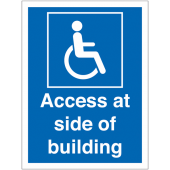
For a simple visual access cue, use wheelchair accessible symbol signs alongside ramp information. This helps people recognise the route before reading extra detail.
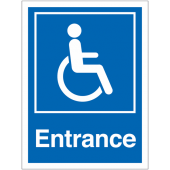
Where the ramp leads to a doorway, fit accessible entrance signs for visitors to confirm they are heading to the correct access point. Helpful for public buildings and shared workplace entrances.
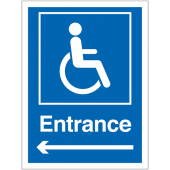
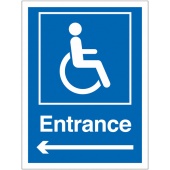
If people must turn left to reach the entrance, choose wheelchair entrance left arrow signs for clearer movement through the site. Useful where the entrance is around a corner or beyond the first doorway.
For parking and access routes together, compare disabled bay and access parking signs before finalising your sign layout. This helps you keep messages consistent from bay to building.
Estimated Delivery Day
Current date and time:
Estimated delivery by:
Based on an estimated 3 working day delivery timeframe from today, excluding weekends and bank holidays. Delivery dates are provided as a guide only and may vary depending on the product ordered, stock availability at the time of purchase, production or printing lead times.